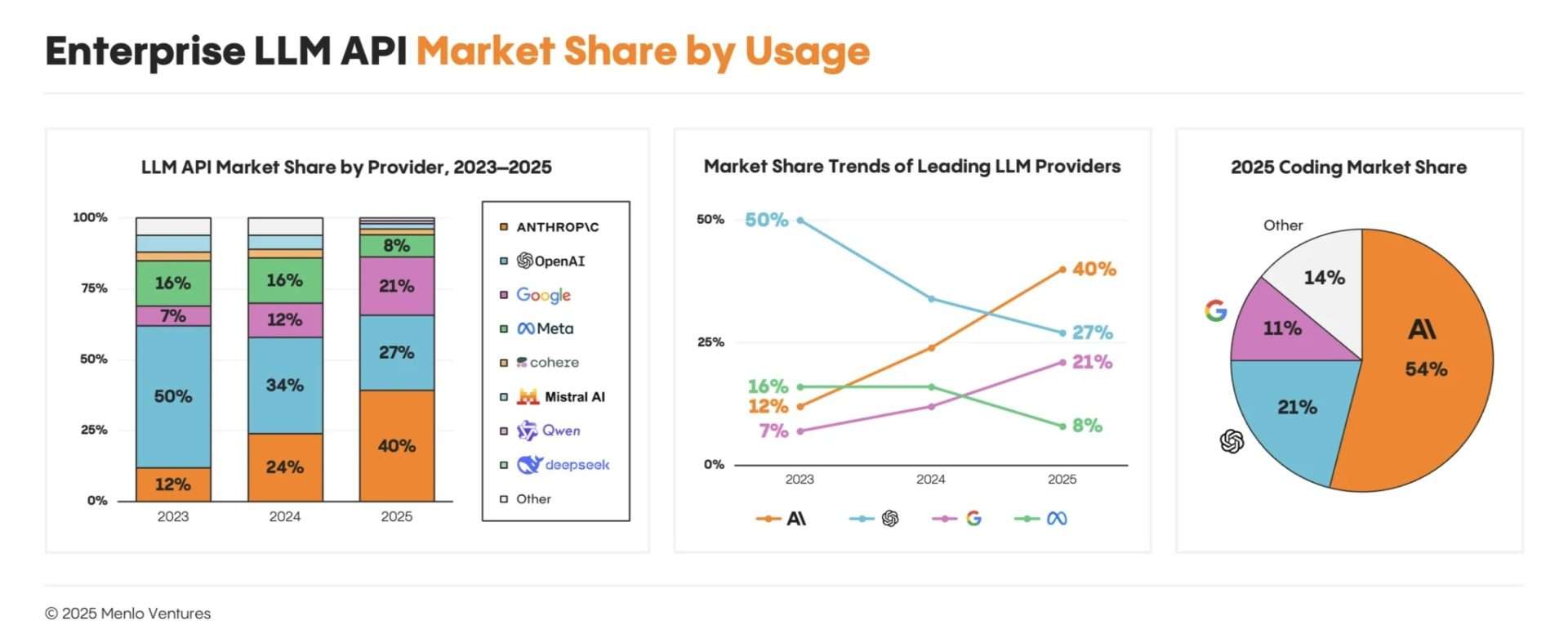
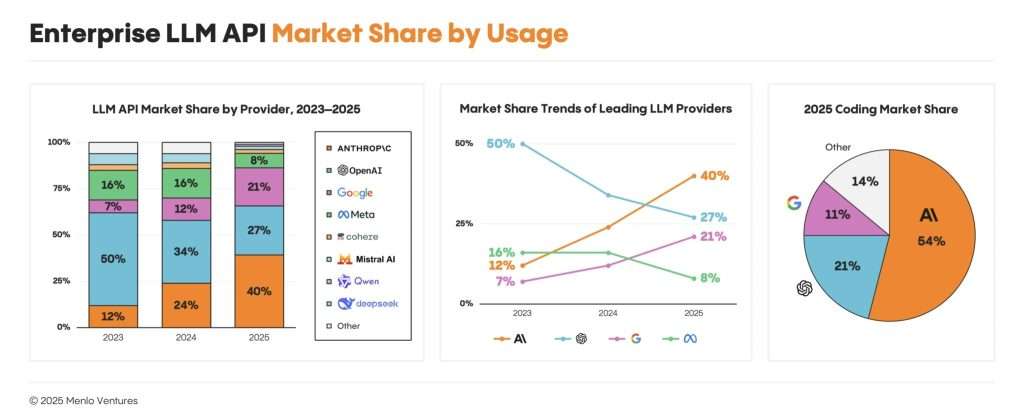
In the sector Enterprise , generative artificial intelligence has taken an unexpected turn. The language model most used by companies is no longer ChatGPT or Gemini, but Claude , by Anthropic , with a 40% share, followed by OpenAI (27%) and Google (21%) solutions. This data, from a report by Menlo Ventures in December 2025, surprises many managers accustomed to the media dominance of ChatGPT. It should be clarified that it is a question of market share in use, not revenue : That is, it reflects the percentage of business usage for each model, not the billing of its suppliers. Still, the corporate AI landscape is fragmenting, and no single model holds an undisputed monopoly anymore.
This wasn't in the script
Two years ago, we took it for granted that ChatGPT was the "winner" in AI . In companies or universities, if someone asked which artificial intelligence was leading, the answer seemed obvious: ChatGPT , and end of the discussion. The alternatives (Claude, Bard, the first Gemini...) were seen as interesting but secondary tools. However, the last months of 2025 marked a turning point. In November, OpenAI released GPT-5.1, Anthropic counterattacked with Claude 4.5, and Google responded days later with Gemini 3. Three large, almost simultaneous launches that announced the End of the era of the winning single model .
The results are visible: Anthropic – with its Claude model – has dethroned OpenAI in the enterprise . OpenAI, which in 2023 accounted for half of the enterprise market for LLMs, fell to 27% in 2025. Google, for its part, rose to 21% thanks to the integration of its models (such as Gemini) into its product ecosystem. And Anthropic reached the 40%, consolidating himself as an unexpected leader. For CEOs, this change in leadership is not just a statistical curiosity, but a sign that The dynamics of the sector have changed : the Enterprise AI is no longer a single-player game .
It is worth asking How is it possible that Claude, relatively less famous, dominates the use in companies? The answer lies in the use cases. Claude has been particularly successful in one critical niche: code generation and developer support. In fact, Anthropic already owns 54% of the AI market for coding in companies , leaving OpenAI with just 21% in that field. Technical teams' preference for Claude (thanks to his ability to handle extensive codebases and reduce errors) has driven his adoption. This illustrates a key point: in corporate environments, the best AI depends on for what Let's use it.
Each model shines on one thing
Far from there being a single off-road champion, what we see is A fragmented ecosystem depending on the use case . We could compare it to a team of specialists: it is not a league with a single champion, but having the best player in each position. For example Gemini 3 (Google) has proven to be a leader in complex reasoning, scientific and mathematical analysis, while ChatGPT continues to excel in the generation of narrative and argumentative texts. For searches with up-to-date information and reliable citations , tools such as Perplexity AI stand out, and Claude has earned the respect of developers in Jobs with code and management of large contexts.
This Paper division The new standard is starting to be:
- ChatGPT (OpenAI) – Specialist in text writing, generation of narrative content and coherent arguments.
- Gemini 3 (Google) – Powerful in complex reasoning, strategic scenarios, mathematical calculations and deep analysis.
- Perplexity AI – Research tool that Find, contrast, and cite sources of up-to-date information, ideal for searches with context.
- Claude (Anthropic) – Programming Assistance Expert: Helps write code, debug, and maintain extensive context without losing the thread.
- NotebookLM (Google) – A research and study assistant, capable of analyzing documents provided by the user and extracting knowledge in an interactive way (useful for internal training or synthesis of long reports).
- Voice and Video Models – Specialized solutions for non-text tasks: for example, voice AIs for transcription or audio generation, and video AIs for visual content creation or multimedia analysis. These tools cover specific needs that pure language models do not address.
The conclusion : there is no single AI that is the best at everything , but several AIs excelling each in their own way . This explains why organizations are sharing the use among different providers: companies are combining tools to take advantage of the strengths of each model in each area. In total, the big three (Anthropic, OpenAI, Google) account for 88% of the use of LLMs in companies, but the remaining 12% corresponds to a long tail of players such as Meta (Llama), Cohere, startups such as Mistral, and even open-source models adapted to niches. The landscape is more diverse than ever , a sign of a rapidly maturing market.
Multi-model: it's not fidelity, it's architecture
This new scenario requires rethinking corporate AI strategy. Traditionally, many companies chose to marry a single ecosystem ("we're from Microsoft" or "we're from Google"), trusting that that provider would give them the optimal AI solution. But If even the giants are avoiding the single-vendor model, a medium-sized company shouldn't tie its hands and feet to a single player . Microsoft and OpenAI, for example, have recalibrated their relationship, allowing OpenAI to collaborate with other partners; Google has opened up its platform to external integrations. The question is no longer one of brand loyalty, It is of technological architecture .
In Proportione we have been insisting on this idea for some time. In fact, in an analysis published after the launch of Gemini 3 we stressed that "The era of the omnipotent model is over; The winning strategy is not about choosing a model, but about learning to orchestrate Miscellaneous models according to the task" . It is what we call a Multi-model strategy . Instead of asking "Which AI model is the best?" , leading companies ask themselves "Which model is best for each specific need?" . This way of thinking, more complex at first, is bearing tangible fruit: Recent studies comparing "single-model" implementations vs. multi-model strategies show significant differences in return on investment , in favour of the multi-model approach. In other words, organizations that stop looking for an absolute winner and move to a "winners by area" scheme capture more value, faster .
Our practical experience confirms this trend. In Proportione , for example, We have adopted a pragmatic and multi-model approach : we use Claude when it comes to generating or reviewing code (where it excels), we prefer NotebookLM or Perplexity for the study of documents and research tasks, we take advantage of ChatGPT in writing and synthesis of texts, and we do not hesitate to resort to voice or video models when a project requires it. This Open-mindedness and use-case-oriented mindset it has allowed us to offer effective AI solutions without marrying ourselves to a single technology. It's not about making Self-promotion , but to illustrate a mature approach: just as There is no single tool that is valid for all your business operations , there is no artificial intelligence either.
Implications for decision-making
What does all this mean in practice for a CEO? First of all stop looking for "the best AI model" as a one-time decision . The real competitive advantage will not come from choosing a miracle model, but from choosing a miracle model. Design a system where multiple models collaborate in your favor . To move in that direction, consider these actions:
- Map needs according to the type of task: Analyze which parts of your business depend primarily on the Text generation (e.g., reporting or content marketing), which ones require Complex reasoning and analysis (strategic planning, simulations), which involve Fast research with reliable sources (documentation, knowledge of the market) and which ones revolve around the Code or Software Development . Don't forget to identify needs for audio/video or other formats if there are any (e.g., voice customer support, security video analytics, etc.).
- Associate each area with the most appropriate AI: Once the tasks have been categorized, Choose the leading model in each category . It can mean integrating ChatGPT or Gemini into your planning department, using Claude to assist your developers, deploying an assistant like Perplexity or NotebookLM for the research team, and so on. Consider criteria such as Data Privacy (some areas may require on-premise or open-source models) and ease of integration with your existing systems.
- Accepts a multi-vendor architecture: your AI ecosystem is likely to involve Various vendors and tools . This breaks with the comfort of before, but it is necessary. It makes no sense to cling to "we are a 100% X supplier company" in a world where each supplier shines in something different. Be prepared to manage contracts, APIs, and SLAs with multiple technology partners.
- Prepare your team and adjust processes: investing in AI is not only a matter of technology but also Organizational . Make sure you give your professionals Time and training to familiarize yourself with several tools at once. Establish clear protocols: for example, when should your analysts ask ChatGPT for a first draft, when is it best to consult Gemini for scenario analysis, or when to use Perplexity to verify a piece of data? At the same time, it defines which decisions or tasks no you will never fully delegate to an AI, no matter how brilliant its results are (human supervision is still crucial).
Taking this path Requires strategic vision . It means recognizing that AI is not a plug-and-play magic monolith, but a set of powerful tools that you have to know how to combine. The payoff, however, is worth it: for the first time, companies can imagine truly transformative AI deployments without having to give up your preferred tech stack . You can get world-class AI by staying in Google Workspace or Microsoft 365 environments, as long as you bring in the right models in an orchestrated way.
And Claude's leadership in business teaches us that the AI race does not have a single winner, but several, and that Your advantage as a business will depend on how you know how to play with all of them . The question is no longer "which AI wins" (that competition no longer exists, as an analysis by Proportione put it). The relevant question is How you're going to organize your own "inner league" of artificial intelligences and people so that they all add to your strategy. Different models shine in different tasks, and in that well-managed diversity lies the new success factor. The next few years will be played out in this field: in the capacity of each organization to Design hybrid systems where humans and various AIs collaborate in an intelligent, sustainable and clear way. Those CEOs who understand and act on it first—embracing a multi-model strategy wisely—will have a noticeable advantage in the age of mature AI.
Sources: Model usage quotas data comes from the report State of Generative AI in the Enterprise 2025 by Menlo Ventures. Reflections on the multimodel strategy extracted from Proportione analysis (J. Cuervo, 2025) and other specialized publications. In Proportione we have already thoroughly compared models such as Gemini 3 vs. ChatGPT in our blog, concluding that the question is not who is better overall, but who is better in everything . These examples reinforce the central idea: there is no single clear winner in AI, and therefore the smartest strategy is the right combination of multiple artificial intelligences at the service of business objectives .