Migrate a proprietary CMS to a modern content manager
Your website relies on a content manager that no longer evolves. Every change costs more than it should, and almost no one knows how it works under the hood.

Your website relies on a content manager that no longer evolves. Every change costs more than it should, and almost no one knows how it works under the hood.
Your website relies on a content management system that no longer evolves. Every change costs more than it should, and almost no one knows how it works under the hood. We help you move that content to a modern platform without losing sight of what already brings you traffic.
To start, just describe the system. Do not send credentials or databases.
Request your Proportione Legacy diagnosis
While the website works, nobody notices. The cost appears when something needs to be changed and cannot be, or when the person who knew how it worked is no longer there.
What it means for you: the problem is not the website the visitor sees, but what is behind it. Next step: the diagnosis, which we explain below.
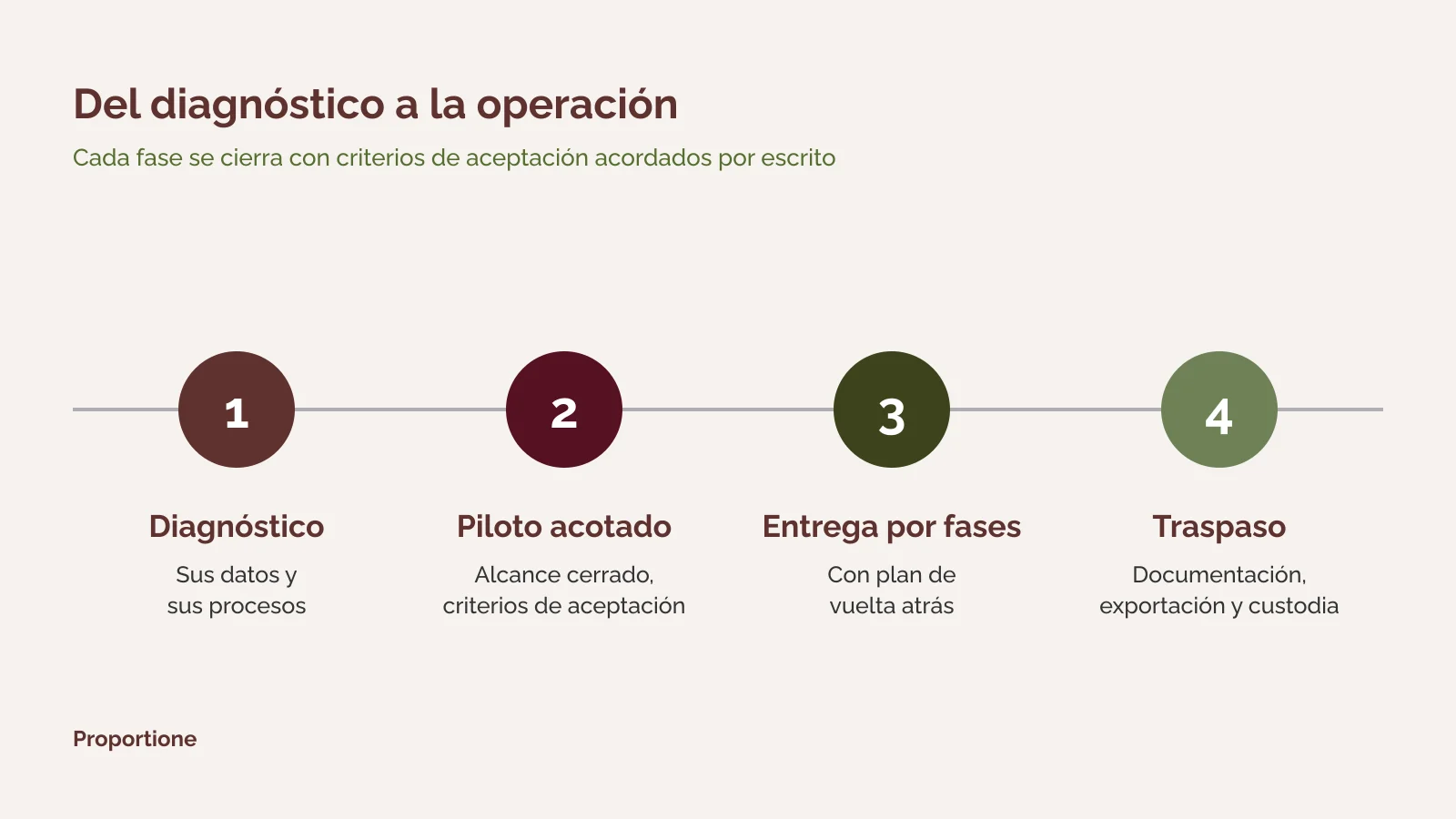
We start with a diagnosis of your data and processes before choosing a destination. It delivers an inventory of processes and data, options (build, buy, or connect), and a phased scope proposal. The general details of the method are in how we work.
We can analyze what is kept, what is missing, and what transition options exist. In a content manager that means listing content types, pages, media, users, and extensions, and checking how each item can be extracted.
When appropriate, we conduct a limited pilot with pre-defined acceptance criteria before proceeding.
We deliver in phases, with acceptance criteria in each one and with a rollback plan.
Documentation, export, and verifiable custody are part of the design from the beginning.
What it means for you: at any given moment, you know what has been moved, what is missing, and how to roll back. Next step: request the diagnosis.
Changing the manager alters the format of addresses, titles, and structure. If not handled carefully, search engines will not find what they used to find. That is why it is done in this order:
1. URL inventory. All existing addresses are gathered: those from the sitemap, those appearing in analytics and Search Console, and those receiving links from other websites. 2. Redirection map. Each old URL is mapped to its new equivalent, and a 301 redirect is configured. What no longer has an equivalent is decided intentionally, not by omission. 3. What already works is preserved. Titles, descriptions, headers, and structured data that currently fulfill their purpose are carried over to the new platform. 4. Testing before the change. The new platform is reviewed in a staging environment against the inventory. 5. Post-change verification. The response codes of the inventory URLs, the new sitemap, and the evolution in Search Console are verified.
No migration can promise that rankings will remain identical. What can be done is to measure beforehand, proceed with criteria, and check afterwards.
What it means for you: has the list of what is being moved and how it is verified right in front of them. Next step: tell us what CMS you have and approximately how many pages your website has.
A Joomla website with a team publishing content daily is one of the most common migrations. WordPress is a frequent destination, but not the only one: the diagnosis compares the options with your specific case.
What it means for you: knows in advance what transfers as-is and what needs to be rebuilt. Next step: include in your message the version of Joomla you are using, if you know it.
Drupal 7 no longer has support from its official project: according to the project itself, its end of life was January 5, 2025. Websites that remain on that version have to decide where to go.
There are two usual paths: upgrade to a current version of Drupal or move the content to another manager. The answer depends on how much custom logic the website has and who maintains it.
What it means for you: a website that doesn't receive support requires choosing a destination with criteria. Next step: request a diagnosis and review the options in phases.
A proprietary manager is one built by a vendor or an internal team for a single company. Without a community or public documentation, all knowledge resides with a few individuals.
We worked with an organization with a proprietary content manager that had not evolved for many years. The starting point was an inventory of its contents; then it was migrated to a modern platform, in phases.
When there is no code or documentation, you don't start with a promise but with a verification: what can be extracted, in what format, and what is left out.
What it means for you: Knowing what your manager contains is the first step, even if you later decide not to move it. Next step: Describe the manager and who maintains it today.
In an online store, in addition to content, there are products, customers, orders, and addresses that are already positioned. The method is the same and an additional check is added: that orders and customers pass completely and verifiably.
What it means for you: the store is not touched until there is an inventory and a rollback plan. Next step: indicate the platform and version.
What it means for you: you are not tied to us to move forward. Next step: request the diagnosis.
Before opening anything and before adding AI, the content and processes must be understood. Once organized, the manager can be connected to the rest of your systems via APIs. Only then does it make sense to apply AI on top.
AI can run on its own server and, if necessary, without an internet connection. It is explained in legacy systems migration service, and you can see how it fits into artificial intelligence in business.
What it means for you: organizing avoids paying twice for the same thing. Next step: if what you need is to build something custom and not just move a manager, see custom software development; if your website is built in .NET, see migrate a .NET website to WordPress; or check our services and Business Management Consulting.
It cannot be promised that it won't change. What we do is reduce risk with a method: URL inventory, 301 redirects one by one, preserving what already works, and checking after the change. Evolution is reviewed in Search Console.
It depends on what's there. We can analyze what is kept, what is missing, and what transition options exist. The diagnosis addresses this before committing to the rest of the work.
WordPress is a common destination for content websites, but not the only one. The diagnosis compares options based on who publishes, what features are needed, and what systems it must connect to.
The Drupal project set the end-of-life for Drupal 7 for January 5, 2025, according to its official page. We start with an inventory of the site and its modules, and decide whether to update or change managers.
The method is the same, with an added check on products, customers, and orders. Acceptance criteria are agreed upon before moving anything, and a rollback plan is prepared.
It depends on the scope: how many pages and content types there are, which extensions are redone, and which systems it connects to. The diagnosis ends with a phased scope proposal, and from there it is specified. We do not give a figure or deadline without knowing your case.
Tell us what content management system you have and what you need. We will respond within a maximum of two business days. You can also write to us from the contact section. [Short form: see specification in notes]
Request your Proportione Legacy diagnosisDo not send credentials or databases. We will use your data only to respond to you; more information in the Privacy Policy.