Custom CRM for businesses
Your way of selling is yours, and your CRM forces you to tell it another way. Customer data lives in spreadsheets, in a product that doesn't fit, or in someone's head.

Your way of selling is yours, and your CRM forces you to tell it another way. Customer data lives in spreadsheets, in a product that doesn't fit, or in someone's head.
Your way of selling is yours, and your CRM forces you to tell it another way. Customer data lives in spreadsheets, in a product that doesn't fit, or in someone's head. We design and develop custom software for companies, including CRMs, and we start by understanding how you sell before writing a line of code.
To start, just describe how you work today. Do not send credentials or databases.
Request your Proportione Legacy diagnosis
A CRM is management software: when your sales process fits a market product, there's no need to build. We start there because it avoids useless meetings for both of us.
What it means for you: Before building, three options (build, buy, or connect) are compared and chosen using your company's data, not intuition. Next step: the three situations below, and the general method in custom software development.
For many companies, a spreadsheet acts as a CRM. The problem isn't the spreadsheet: it's that no one has written down what it contains, who uses it, and what decisions are made with it.
We start with a diagnosis of your data and processes before choosing a destination. It delivers an inventory of processes and data, the options (build, buy, or connect), and a phased scope proposal. Sometimes the destination is a market product; other times, a custom CRM. If the sheet has macros and functions as an application, see macros and Excel sheets that function as an application.
What it means for you: you know what you have in your spreadsheets before deciding what to do with it. Next step: describe in the form how you currently manage your clients.
When the spreadsheet no longer answers the business questions: who has spoken to whom, at what stage is each opportunity, what was promised to the client. There is no company size or number of rows from which it is mandatory; the diagnosis, with your data, decides.
Migrating a CRM means moving contacts, history, and rules from one system to another, and the sales team must be able to continue working. That's why you don't start with the destination, but with an inventory of what you have: what data, from where, and with what rules.
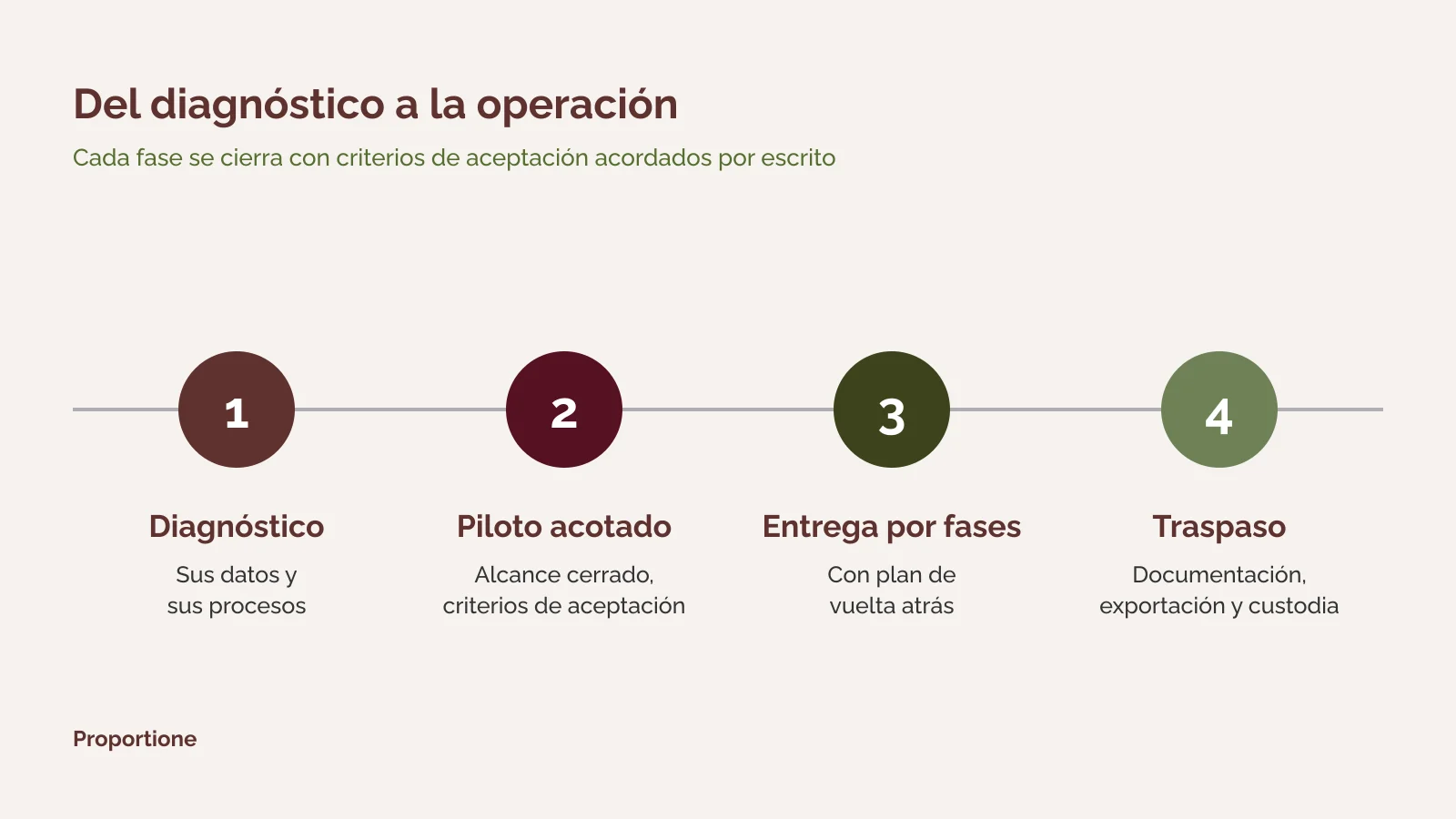
We deliver in phases, with acceptance criteria for each and a rollback plan. The rollback plan is part of the design, not an add-on. And verifiable documentation, export, and custody are part of the design from the beginning: it's written down how to exit.
What it means for you: at all times, you know what has been moved, what is missing, and how to roll back. Next step: if your current CRM is unsupported or your provider is no longer evolving the product, start on the page legacy systems migration service.
An inventory of your data and processes, a chosen destination with criteria, and phased delivery with pre-set acceptance criteria. You don't need to decide on the destination to start: diagnosis is the first step.
A market product is designed for many clients at once; a custom CRM, for your process. Neither is inherently better. These are the criteria for deciding:
What it means for you: The comparison is made with written criteria and your specific case, and it may turn out that the best option is not to build. Next step: Request the diagnosis, which compares the three options. If what you need covers the management of the entire company and not just sales, see Custom ERP.
If an off-the-shelf product meets your needs without forcing you to change your workflow, it's usually the best option. A custom CRM is worthwhile when your sales process is unique or when a product would force you to change what makes you different. There's a third way: connecting what you already have. The diagnosis compares these three.
The general details of the method are in how we work.
Inventory of processes and data, options (build, buy, or connect), and phased scope proposal.
When appropriate, we conduct a limited pilot with pre-defined acceptance criteria before proceeding.
Each phase has its acceptance criteria and a rollback plan.
Documentation, export, and verifiable custody are part of the design from the beginning.
What it means for you: you are not tied to us to move forward. Next step: request the diagnosis and review the phased proposal. If you want to see everything we do, consult Business Management Consulting and our services.
We consider AI later, once the process is understood and the data is organized. AI can run on your own server and, if necessary, without an internet connection.
What it means for you: your customer data does not have to leave your premises. Next step: see how it fits into artificial intelligence in business.
It depends on the scope: how many processes are involved, how much data needs to be organized, and what systems it connects to. That's why we don't give a figure without knowing your case. The diagnosis ends with a phased scope proposal, and from there, it is specified.
The code belongs to the client, and this is explicitly stated in the contract. Documentation, exportability, and custody are verifiable and form part of the design.
Yes. Data extraction, migration, and any AI used subsequently can be run on your servers or on dedicated hardware, even on an offline network.
Tell us what system or process you have or need. We will respond within two business days. [Short form: see specification in notes]
Request your Proportione Legacy diagnosisDo not send credentials or databases. We will use your data only to respond to you; more information in the Privacy Policy.