Integrating legacy software with APIs and connectors
Your legacy system works, but it doesn't communicate with the rest. Someone exports a file, another person imports it into another program, and the same data is entered twice.

Your legacy system works, but it doesn't communicate with the rest. Someone exports a file, another person imports it into another program, and the same data is entered twice.
Your old system works, but it doesn't talk to the rest. Someone exports a file, another person imports it into another program, and the same data is entered twice. This page explains how to connect old software with the rest without replacing it, when a connector is enough, and what needs to be organized before putting AI on top.
To start, just describe what systems you have and what they exchange. Do not send credentials or databases.
Request your Proportione Legacy diagnosis
Each query has its section, with its own questions:
Integration means making two systems exchange data without a person acting as a bridge. It doesn't require replacing either. The useful question isn't what technology to use, but what data needs to get where, when, and who needs it.
That's why we start with a diagnosis of your data and processes before choosing a destination. It delivers an inventory of processes and data, the options (build, buy, or connect), and a phased scope proposal.
What it means for you: Know what data moves today, between which systems, and manually or not, before deciding. Next step: choose the section below that resembles your case.
Point-to-point integration is a direct connection between two programs, custom-made for those two: a file that one leaves and the other picks up, a direct query to the other's database, a macro in Access or Excel that copies data. It works when there are two. When there's a third, other connections must be made, and each change in one forces a review of those it affects. The number of connections grows faster than the number of systems.
An API is a documented and unique gateway: the system defines what data it offers and how it's requested, and others connect to that gateway instead of its internals. If the old system doesn't have an API, a layer can be placed in front to perform that role, without changing what's inside.
What it means for you: each new system stops being a connection project with all the others. Next step: request a diagnosis and indicate which programs exchange data today.
It is a direct and specific connection between two programs, without a common layer: an exchanged file, a query to the other's database, or a macro that copies data. It solves a specific case and is quick to set up. Its cost appears when adding systems or changing one of the two.
Not necessarily. If the system does not have an API, a layer can be placed in front of it to expose it, without replacing it. Whether it's worth it depends on whether the system is a solid foundation or a risk in itself. This is decided in the diagnosis.
They would be inventoried as part of the diagnosis: what they move, between which systems, and who depends on them. Some are kept, others are replaced by a more orderly connection, and those no longer used are retired. Each decision is documented in the phased proposal.
A connector is a piece that reads data from one system and delivers it to another in the format that the latter understands. It can be read-only: it reads from the old system and does not write to it, so it does not modify its data.
A connector is enough when you need another system to see the data from the old one, and the old one continues to do its job well. If the old system is no longer supported or is a risk in itself, connecting it does not solve that problem; then the option is different.
What it means for you: keeping what works is a real option, not an exception. Next step: if your system no longer has support, start on the page legacy systems migration service.
Request your Proportione Legacy diagnosis
It is a connector that reads data from the old system and does not write to it. It serves so that another system, a report, or a tool can view that data without modifying the original. If writing back is also necessary, it is another decision, made with more care, and is valued separately.
It depends on what the system offers: it may export files, have an accessible database, or its own interface. What path exists is determined during the diagnosis. If there is no reasonable option, it is a signal to consider other solutions.
It is a solution as long as the old system continues to function. If the system eventually becomes a risk, the connector will not fix it. That is why the diagnosis compares the three options and not just connecting.
We consider AI afterwards, when the process is understood and the data is organized. The integrations above are part of that order: before an AI consults your systems, it is advisable to access your data through a defined channel and not through a file that someone copies.
Organizing the data means, specifically, answering some questions before starting:
What it means for you: knows what is missing before considering AI, and does not buy it only to discover later that their data is not ready. Next step: ask for the diagnosis, or read AI with legacy software: where to start.
Not all of them: only those related to the process you want to improve. The diagnosis defines which ones are needed and in what order they should be organized, by phases.
They don't have to. AI can run on your own server and, if necessary, without an internet connection. This is the same option we describe in legacy system migration and in artificial intelligence in business.
Whatever the option, the method is the same. General details are in how we work.
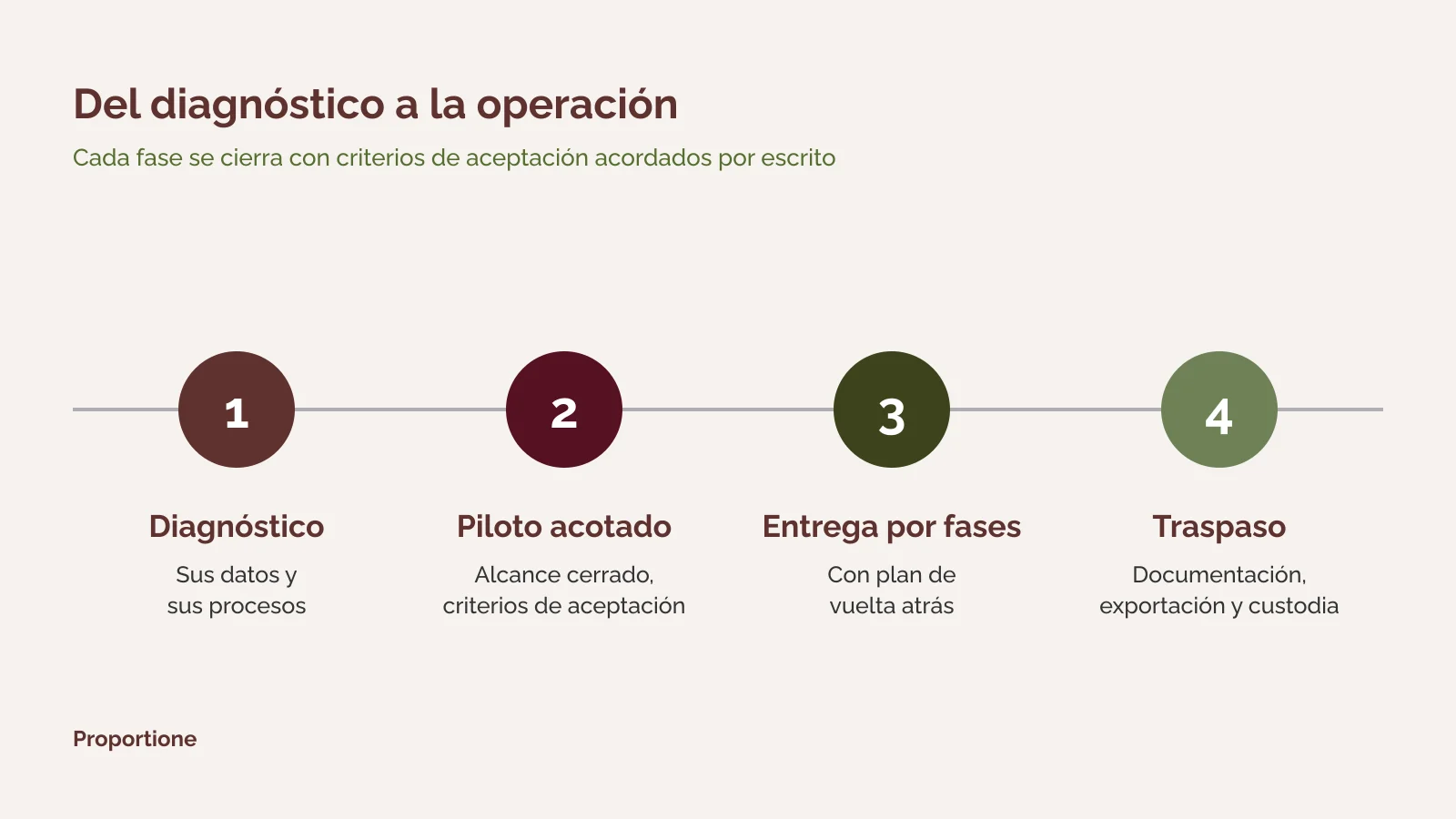
1. Diagnosis: process and data inventory, options (build, buy, or connect), and phased scope proposal. 2. Scoped pilot, with pre-established acceptance criteria before proceeding, when the case requires it. 3. Phased delivery, with acceptance criteria and a rollback plan. 4. Handover: verifiable documentation, export, and custody. The code is yours, and that is stated in the contract.
What it means for you: at all times you know what has been delivered, what is missing, and how to roll back. Next step: request the diagnosis.
The order is always the same. First, you digitize and understand the process. Then, you open the old software with APIs and connectors to link it with the rest. Only then do you consider AI on top of it.
If what you need is to build something of your own instead of connecting, see custom software development and, for company management, Custom ERP. For the entirety of what we do, consult Business Management Consulting and our services.
What it means for you: each step builds on the previous one and you can stop at the one that suffices. Next step: Describe your case in the form below.
With a diagnosis of your data and processes, before choosing a destination. It delivers an inventory of processes and data, the options (build, buy, or connect), and a phased scope proposal.
It depends on the scope: how many systems are involved, what data is moved, and how the legacy system can deliver it. That is why we do not give a figure without knowing your case. The phased scope proposal is where this is specified.
It depends on the scope. We work in phases, each with its acceptance criteria, and the schedule comes from the phased scope proposal. We do not give a single timeframe without knowing your case.
It is delivered in phases, with acceptance criteria and a rollback plan, so that each step can be verified and, if necessary, undone. How each phase is organized is defined in the proposal.
Yes. AI can run on its own server and, if necessary, without an internet connection.
The code belongs to the client, and this is explicitly stated in the contract. Documentation, exportability, and custody are verifiable and form part of the design.
Tell us what systems you have and what data is passed between them. We will respond within two business days. [Short form: see specification in notes] If you prefer to write to us directly: contact.
Request your Proportione Legacy diagnosisDo not send credentials or databases. We will use your data only to respond to you; more information in the Privacy Policy.