Custom software development for companies
Your process doesn't fit into a market product. It lives in spreadsheets, in someone's head, or with a supplier you depend on.

Your process doesn't fit into a market product. It lives in spreadsheets, in someone's head, or with a supplier you depend on.
Your process doesn't fit into a market product. It lives in spreadsheets, in someone's head, or in the hands of a vendor you depend on. We design and develop custom software for companies, and we start by understanding your process before writing a single line of code.
To start, just describe the process. Do not send credentials or databases.
Request your Proportione Legacy diagnosis
When the market already offers a solution, there are better options. We start there because it avoids useless meetings for both of us.
What it means for you: Before building, compare three options (build, buy, or connect) and choose based on your company's data, not intuition. Next step: the diagnosis, which we explain below. If you already know which system you need, it has its own page Custom ERP and the Custom CRM; if you are undecided between package, custom, or connect, see business management software.
First, we understand your data and processes; then, we decide the destination. The general details of the method are in how we work.
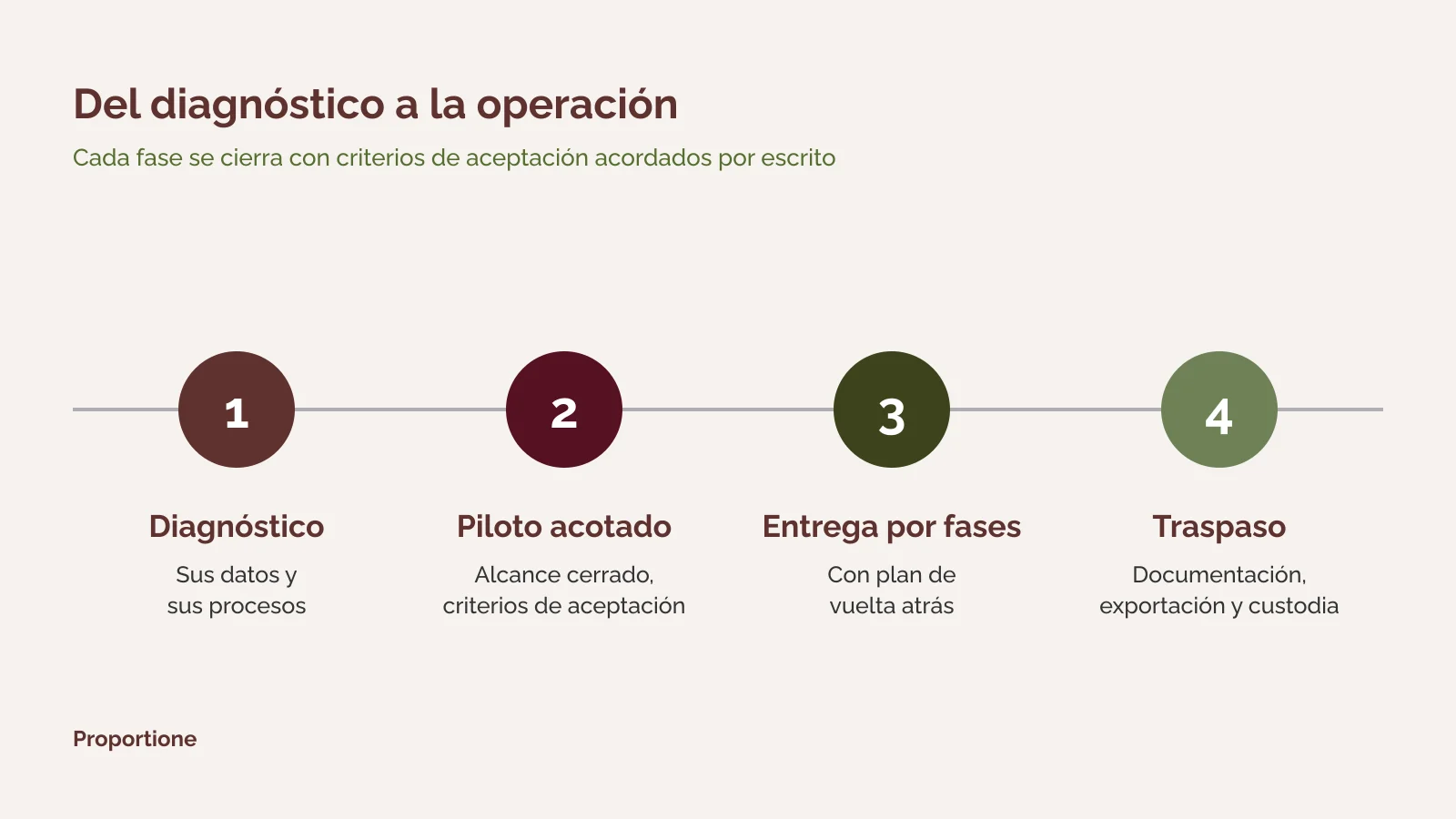
We start with a diagnosis of your data and processes before choosing the destination. It provides an inventory of processes and data, the options (build, buy, or connect), and a phased scope proposal.
When the case requires it, a limited pilot is conducted with pre-defined acceptance criteria before proceeding. If the pilot does not meet the criteria, it is reviewed before committing to the rest.
We deliver in phases, with acceptance criteria for each phase and a rollback plan. The rollback plan is part of the design, not an add-on.
Verifiable documentation, export, and custody are part of the design from the beginning: how to exit is put in writing.
What it means for you: at all times knows what has been delivered, what is missing, and how to go back. Next step: request the diagnosis.
What it means for you: you are not tied to us to move forward. Next step: request the diagnosis and review the phased proposal.
Before opening anything and before adding AI, the process must be digitized and understood: what steps it has, who performs them, what data it uses, and where it resides today. This is the first step of the diagnosis and does not depend on a specific technology.
Sometimes the result is an ordered process that a market product already covers. Other times it is the basis on which it is custom-built. In both cases, progress is made in phases.
What it means for you: knows what they have before deciding what to do with it. Next step: if you want to see the whole of what we do, consult Business Management Consulting and our services.
Once the process is understood, one of the three diagnosis options is to connect: open the system you already have with APIs and connectors and join it with the rest, without replacing it.
What it means for you: keeping what works is a real option, not an exception. Next step: if your system has no support or its manufacturer no longer exists, start with the page on legacy systems migration service.
We consider AI afterwards, when the process is understood and the data is ordered. That's why it goes in this order: first digitize the operation, then open old software with APIs and connectors, and only then AI on top.
AI can run on your own server and, if necessary, without an internet connection. This is the same option we describe in legacy system migration.
What it means for you: your data doesn't have to leave your facilities. Next step: see how AI fits into your company in artificial intelligence in business or read AI with legacy software: where to start.
What it means for you: if you recognize yourself in any of them, you don't need to know the solution to start. Next step: describe your case in the form below.
It depends on the scope: how many processes are involved, how much data needs to be organized, and which systems it connects to. That is why we do not give a figure without knowing your case. The diagnosis ends with a phased scope proposal, and based on that, it is finalized.
If a market product meets your need without forcing your way of working, it is usually the best option. Custom software pays off when the process is proprietary or when a product would force you to change the very thing that sets you apart. There is a third way: connecting what you already have. The diagnosis compares all three.
The code belongs to the client, and that's how it's stated in the contract. Documentation, export, and custody are verifiable and part of the design.
It depends on the scope. We work in phases, each with its acceptance criteria, and the timeline comes from the phased scope proposal delivered by the diagnosis. We don't provide a single deadline without knowing your case.
Yes. The extraction, migration, and subsequent AI can be run on your servers or dedicated hardware, even on a network without an internet connection.
It's not always necessary to replace it. On the legacy system migration page, we explain how to analyze it and what options exist.
Tell us what system or process you have or need. We will respond within two business days. [Short form: see specification in notes] If you prefer to write to us directly: contact.
Request your Proportione Legacy diagnosisDo not send credentials or databases. We will only use your data to respond to you; more information in the Privacy Policy.