Anthropic — The company behind Claude, the AI model that is winning the enterprise battle against GPT and Gemini — You have just published the most revealing study on artificial intelligence and work. It is not a prediction. It is not a survey. It is an analysis of Over a million real conversations, cross-referenced with the U.S. Department of Labor's O*NET rating. And the main finding is not what AI can do, but how little companies are taking advantage of it. That room for improvement is probably the biggest strategic opportunity of this decade.
The Graph: What AI Can Do vs. What You Use
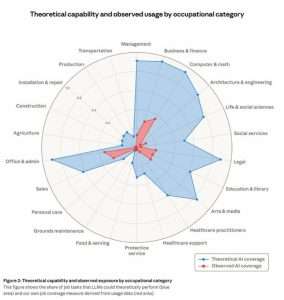
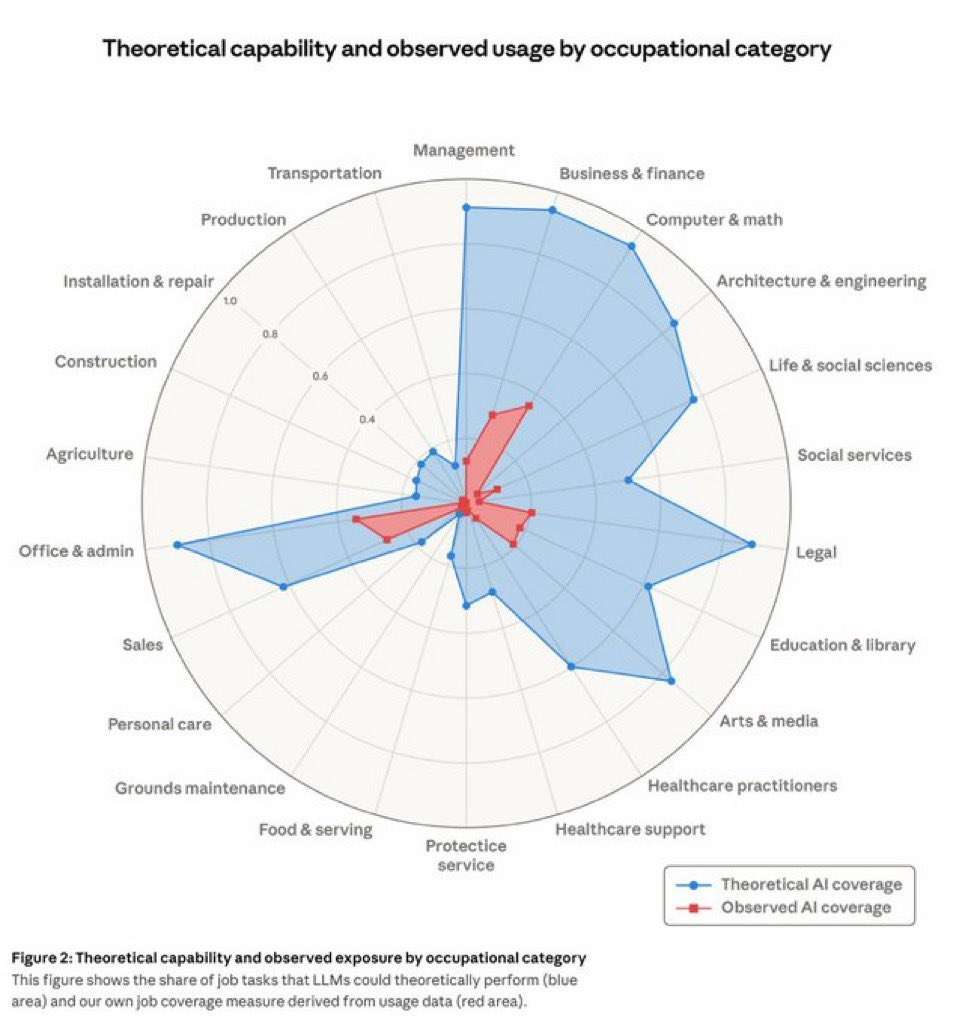
The radar has two layers. The Blue represents the Theoretical coverage: the percentage of tasks in each professional category that language models could perform, according to predictive research by Eloundou et al. (OpenAI, 2023). The red represents the Observed coverage: What people actually do with AI, measured by Anthropic from real-world usage data.
The distance between the two layers — the gap — is the central finding of the study. And it's huge.
Theoretical vs. actual usage coverage by professional category
Source: Anthropic Economic Index · Eloundou et al. 2023
Theoretical coverage (Eloundou et al.)
Observed real usage (Anthropic)
★ Small gap
What the gap says for each sector
The graph does not read the same in all sectors. And the differences tell a story that goes far beyond technology.
Computer science: the largest gap in the world
95% of computer science and math tasks are theoretically achievable by AI. But only 35% is actually covered. It is the largest absolute gap on the graph — 60 percentage points of untapped potential. Programmers were early adopters of AI, and yet they barely use a third of what they could. It's like having a Formula 1 car and driving in the city in second gear.
Education and Art: The Silent Surprise
Both sectors show a theoretical coverage of ~70%, but an actual usage of only ~20%. The gap is 50 points. Teachers, librarians, designers and journalists could use AI in most of their tasks — material preparation, analysis, writing, design — but they don't. The barriers are not technical: they are cultural, regulatory and training.
Legal: the sector that comes closest
Legal is one of the most interesting categories on the radar. With a theoretical coverage of ~65% and an observed use of ~35%, its gap is "only" 30 points. Law firms are adopting AI at a proportionately higher rate than almost any other industry. Why? Because legal work is text-intensive — contracts, jurisprudence, documentary analysis — and the return of AI is immediate and measurable.
Social Services: the gap almost closed
The absolute surprise of the graph. Social Services has a modest theoretical coverage (~35%), but an observed use almost the same (~30%). Only 5 gap points. It is the sector that comes closest to using AI to its maximum theoretical potential. Not because AI can do many of its tasks, but because social workers have found concrete ways to apply it where it does work: documentation, case analysis, follow-up.
Health: the largest relative gap
AI could cover ~35% of healthcare tasks. In practice, health professionals only use it in ~8%. Eloundou et al. predicted a much higher adoption in healthcare; Anthropic confirms that it has not happened. Regulatory barriers, legal liability, and data sensitivity explain this. The gap here isn't a lack of will — it's a wall of compliance.
Physical jobs: the no-gap
Construction, agriculture, transportation, maintenance. Both theoretical and observed coverage are below 12%. There is no gap because there is no significant opportunity. Language AI simply does not apply to physical tasks. These sectors will be transformed by robotics and IoT, not by language models.
Why the gap exists (and what it means for your company)
Anthropic's own researchers say so: "technical feasibility alone is not enough to predict where and how AI will be adopted". The technology is ready. Organizations do not.
The gap is not explained by AI limitations. It is explained by:
- Implementation costs — it is not enough to take out a licence; processes must be redesigned.
- Regulatory barriers — Health, finance, public education operate in frameworks that are not updated at the pace of technology.
- Organizational Readiness — most teams don't know which tasks to delegate to AI or how to validate their results.
Jeff Wilke, who ran Amazon's operations for two decades, summed up this exact problem by talking about Bezos:
"You have enough ideas to destroy Amazon. The solution was to release ideas at the pace that the organization can absorb."
That's the gap in the Anthropic graph turned into a phrase. The blue line is ideas. The red line is the absorption capacity. And Bezos' solution — building an organization that absorbs more, faster — is exactly what companies that want to close that gap need.
Strategy, Technology and People: the trinity that closes the gap
What Anthropic diagnoses in its graph has a familiar name for those of us who work in digital transformation: it is the same old problem. Technology is advancing faster than the ability of organizations to integrate it. And history tells us that the answer has never been more technology.
Look at the two ends of the graph. Computer science has the largest absolute gap (60 points): total access to technology, but without an integration strategy, adoption remains at a third. Social Services has the smallest gap (5 points): less technical potential, but with clear processes, training and committed people, the use is close to the maximum.
The equation that closes the gap
What tasks to delegate.
In what order.
Not the newest,
the most appropriate.
How it is formed.
When you trust.
If any of the three is missing, the gap remains.
The Legal sector closes the gap faster than IT not because it has better technology, but because it has Better adoption strategy: well-defined tasks (contract review, document analysis), measurable return, and people who know exactly what to expect from the tool. Social Services takes it even further: less technical potential, but social workers have chosen The specific tasks where AI helps them — and they use it every day.
By contrast, the sectors with the largest gap — IT, Education, Architecture — share a pattern: access to technology without a framework that connects that technology to the actual workflows of the people who must use it. The gap is not a problem of tools. It is a problem of Integration strategy.
Augmentation, not substitution: what the data says
57% of current AI usage is Augmentation — AI collaborates with people, not replaces them. Only 43% is direct automation. And only 4% of occupations use AI in more than 75% of their tasks. No position is fully automated.
How AI is used today: Augmentation vs. automation
Automation — AI runs on its own
What is happening is more subtle and more urgent: the hiring of 22-25 year old profiles in positions exposed to AI has fallen by a 14 %. Seniors are not fired — the door is closed to juniors. And as the study itself points out, unemployment in exposed positions has not yet changed. Yet.
For managers, the reading is clear: the risk is not that AI will replace your team tomorrow. The risk is that your competition closes the gap before you do. Every point on that graph that a company converts into actual use is a productivity advantage that its competitor doesn't have.
The 20-60-20 model: strategy to close the gap
This is what we Proportione call the Model 20-60-20 — a framework that puts strategy, technology and people in the right place:
AI does the heavy lifting. Your people put the intelligence that matters. Companies that understand this — as the Social Services and Legal data in the graph show — get their teams to adopt the tools and close the gap. Those who don't, stare at the blue line wondering why they don't capture the value.
The Anthropic gap is not closed with more technology. It closes with a clear strategy, the right technology and people ready to work with AI — not in spite of it. The window to prepare is still open. But as the −14% in junior hiring shows, it is already closing.
Do you want to close the gap in your company? How we integrate AI with strategy and people.
Sources: The Anthropic Economic Index (2025) · Eloundou, Manning, Mishkin & Rock, GPTs are GPTs (OpenAI, 2023) · Jeff Wilke interview about Jeff Bezos.
A paradigmatic case of this gap between potential and implementation illustrates this the testimony of a principal Google engineer, where AI did a year's worth of work for his team in one hour.
To understand who is leading this race and with what investments, check out our analysis of The Leading Companies in Artificial Intelligence.